Headless Doesn't Mean Directionless: Why Modern Web Projects Bet on API-First
2026-07-28
Hearing the word "headless" for the first time might sound confusing or like something is missing. But in web design and software development, the term means the exact opposite: maximum control, lightning-fast load times, and uncompromising flexibility.
Growing startups and modern SMEs often face the same digital bottleneck: Traditional Content Management Systems (CMS) like WordPress or TYPO3, which worked perfectly ten years ago, now often feel sluggish, clunky, and high-maintenance.
The way out of this bottleneck is a decoupled architecture (API-first). In this post, you'll learn why separating your frontend from your backend takes your digital product to the next level, how modern AI tools are revolutionizing maintenance, and which headless CMS we use at pargoo - Storyblok, Strapi, or Payload - best fits your vision.
What is a Headless CMS and why is decoupling so valuable?
In a traditional, monolithic CMS, the database (backend) and what the user sees (frontend) are tightly fused together. The CMS dictates not only how content is stored, but also how it’s rendered on the screen.
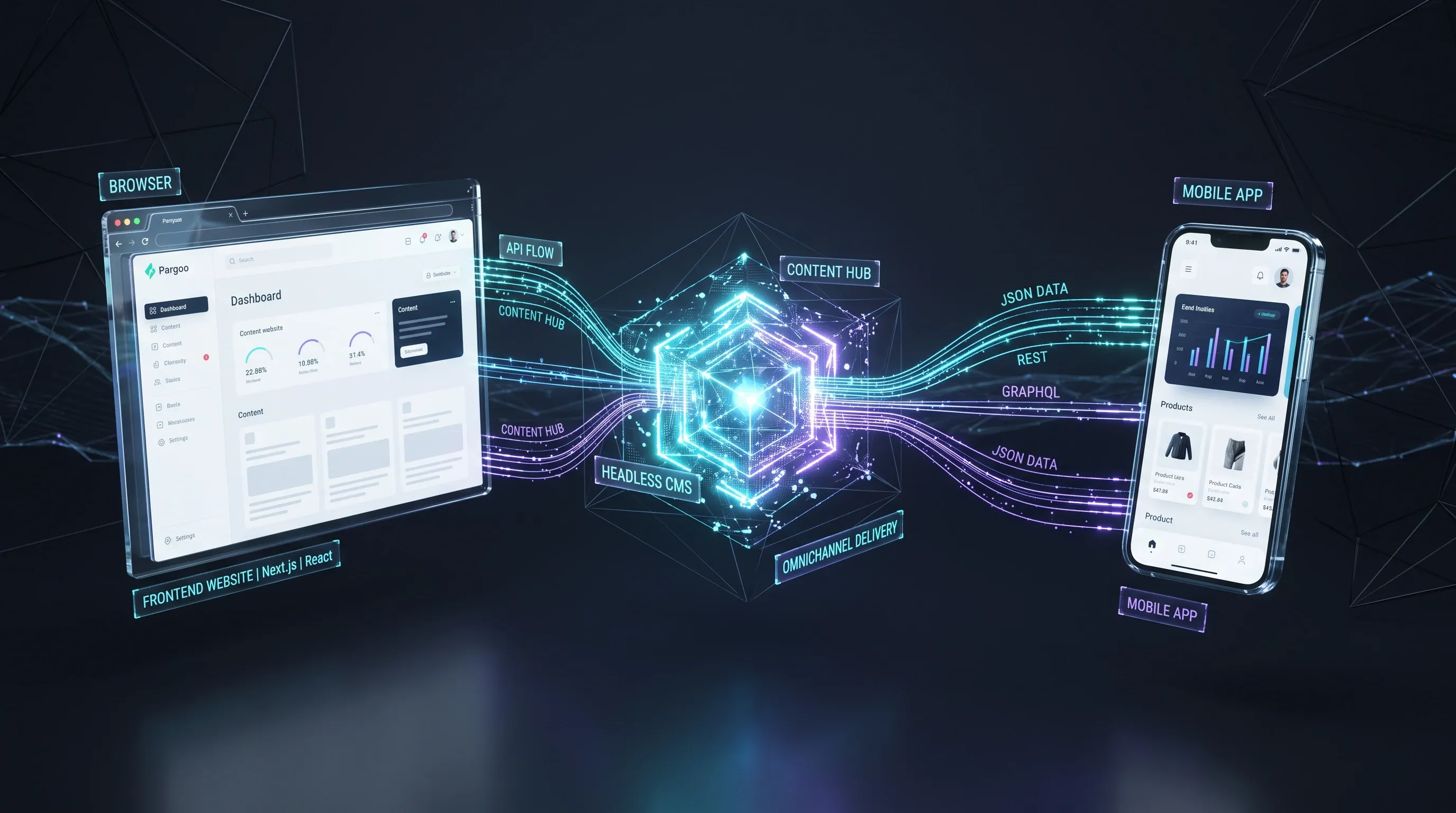
A headless CMS cuts off this "head" (the visual presentation). The CMS is now solely responsible for managing your content, delivering it as pure data (usually via JSON through a REST or GraphQL API).
The advantage of decoupled development:
Because the interface (API) and the design are separated, development teams no longer have to wait on each other. Backend setup and frontend development (e.g., using Next.js) can run completely in parallel. This saves valuable time in the development process and gets your project to market faster.
The maintenance frustration of old monoliths and the AI advantage of modern architectures
Anyone running a classic WordPress or TYPO3 setup knows the drill: Regular updates for plugins, themes, and PHP versions are mandatory to close security gaps. All too often, a single plugin update can break the entire layout or take the website offline entirely (welcome to "dependency hell").
How AI tools are transforming maintenance
In the era of AI-powered coding assistants (like Claude Code, Cursor, or GitHub Copilot), your choice of architecture becomes a real competitive advantage:
- Monolithic systems: AI tools often hit a wall when faced with nested PHP code, opaque plugin dependencies, and outdated template structures. Troubleshooting remains complex and tedious.
- Headless & Modern Stacks: Modern headless systems rely on clean APIs, modular architectures, and often TypeScript. AI assistants can analyze this clean code with extreme precision, write automated tests, and perform extensive refactoring. This makes long-term maintenance not only more secure but also significantly more cost-effective.
The Right Tool for the Job: Storyblok, Strapi, and Payload CMS Compared
There is no universally "best" headless CMS—there is only the architecture that best aligns with your requirements, budget, and workflows. At pargoo, we rely on three proven systems, depending on the use case:
1. Storyblok: SaaS with a Visual Live Editor
Storyblok operates purely as a Software-as-a-Service (SaaS) product. You don't have to worry about backend infrastructure or server updates, and the system offers a very generous free tier to get you started.
- The Strength: The visual editor allows marketing teams to build pages via drag-and-drop and see changes immediately in a live preview—without tying up developer resources.
- Case Study: We built the entire Alpian website dynamically on Storyblok to give their team maximum freedom and autonomy in content management.
2. Strapi: Open Source, Self-Hosted & Highly Customizable
Strapi is the open-source heavyweight among headless systems. It is hosted on your own server, giving you absolute control over your data.
- The Strength: Strapi shines when it comes to complex relational data structures and custom logic. It serves perfectly as a central content hub for a variety of digital channels.
- Case Studies:
- Building a complete e-learning platform for Ready.
- Structured property and content management for Retail Match.
- Scalable content and magazine platforms like HeyCreate and the Famido website.
3. Payload CMS: Lean, Code-First & Frontend-Hosted
Payload is a TypeScript-based headless CMS that can be hosted directly on the same server as your frontend (e.g., alongside a Next.js application).
- The Strength: It is extremely lean and developer-friendly. Because there is no separate backend server to run and maintain, it directly saves infrastructure costs.
- Ideal Use Case: Perfect for smaller websites, specific web applications, or projects where only a small section of the site requires dynamic content.
How do you find the right CMS for your project?
Instead of making you work through rigid checklists, we guide you through a collaborative process to make the right decision. Together, we clarify the key questions:
- Who manages the content? Does your marketing team need a visual click-and-drag editor, or are structured input fields enough?
- Where should the data live? Are there strict compliance rules requiring data to be hosted on your own servers?
- What is the budget for hosting and infrastructure?
- How much will the application grow? Are you planning future expansions or integrations with other systems?
The answers to these questions usually make the optimal technical foundation obvious.
Ready for a future-proof web architecture?
A headless CMS is no longer a fleeting trend; it is the modern standard for high-performance, secure, and scalable web projects. It frees you from the maintenance chaos of old monoliths, speeds up your load times for better Google rankings, and keeps your code clean for the future.
Are you planning a new web project, looking to modernize your existing platform, or searching for the right architecture for your startup or SME?
Let’s find out which setup matches your goals. Get in touch with us in Zurich for a no-obligation chat—we’d love to hear about your project idea!