ready: From printed study materials to a digital learning platform with Strapi
2026-11-16
Printed study materials and flashcards were already an established part of ready's offering. For the autumn semester of 2024, we extended that offering with a digital learning platform. Today, learners can work through courses on desktop or mobile, answer interactive questions and save their progress. Printed materials are still sold and shipped.
The platform opened up new possibilities for ready. People can register to try part of a course before purchasing full access. The team can see which digital content is being used and engage users through Customer.io workflows. Behind this experience is a customised Strapi backend connected to Shopify and a shared frontend application.
The starting point: Add digital learning while keeping printed materials
ready wanted to make its existing learning content available as digital courses, with lessons and interactive questions. That called for central content management tailored to the structure of its learning offering.
Selling printed materials remained an important part of the business. Shopify was already working well for this and needed to continue supporting orders and fulfilment, including the handling and shipping of physical products.
pargoo was responsible for the concept, UX/UI design and web development of the entire learning platform. This included the content model, user interface, learning progress, the Shopify integration and access-code processing.
What digital makes possible: Try a course, buy access and keep learning
A printed study pack has to be shipped before someone can use it. On the platform, ready can make part of a course available directly. People register, try the content and can then purchase the full course.
Registration gives ready a contact before the person decides to buy. The course preview introduces learners to the same environment they will use for the full course.
Learners can save their progress, see what they have already worked through and identify material they need to revisit. Desktop and mobile access lets them choose the device that suits their study session.
Customer.io is integrated too. It supports several engagement workflows, including workflows after users have tried course content. This gives ready a way to stay engaged with users beyond their first look at a course.
Strapi and Shopify: One interface, distinct responsibilities
The learning platform needed a CMS we could extend to fit its requirements. Strapi serves as its backend, centrally managing courses, lessons and interactive questions. Users, course access and learning progress are also part of the learning platform.
Shopify remained connected as the existing commerce system. We integrated it headlessly: the customer-facing storefront is separate from the commerce backend and forms part of the shared frontend application. Users can explore courses and printed products in one interface, without moving back and forth between a learning platform and a separate shop.
For checkout and payment, they move to the Shopify environment. Payment processing stays with Shopify, so the custom learning platform does not have to take on that responsibility.
Each system has a clear role. Strapi supports the custom learning experience, while Shopify continues to support the established sales and fulfilment process.
The critical connection: Turning a purchase into course access
A shared interface is only part of the solution. A purchase also needs to give the right user access to the right course. Returns recorded in Shopify must be reflected in the learning platform as well.
Courses therefore need to be linked to the corresponding products, and users need to be matched across both systems. Shopify sends purchase and return events to the Strapi integration through webhooks. A webhook is an automatic message that tells another system when an event occurs.
The integration processes those messages so that course permissions in Strapi reflect the relevant purchase status. If a message cannot be processed, processing is retried. Error logs help trace problems and investigate unresolved failures.
This synchronisation was central to the architecture. Sales take place in Shopify, while access to learning content is managed in Strapi. Both sides need to associate purchases and returns with the correct users and courses.
Printed materials also provide a route to digital learning
An online purchase is not the only way to get digital access. Printed materials include access codes for the digital version. These codes are processed directly in Strapi.
There are therefore two routes to full course access: a purchase synchronised from Shopify, or an access code included with a printed study pack. The resulting permissions are managed in the learning platform.
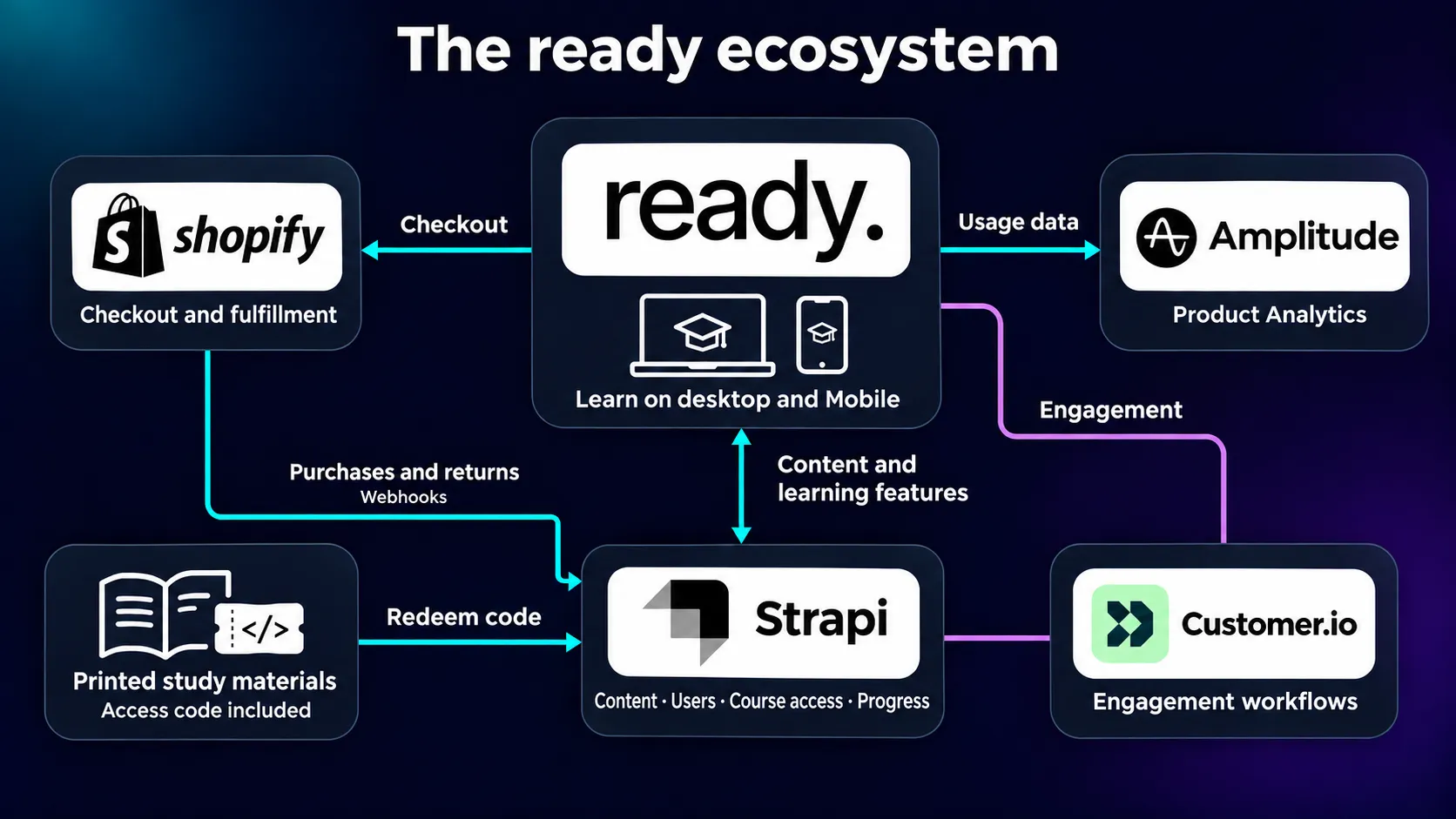
The ready ecosystem: Strapi manages content and learning features, while Shopify supports checkout and fulfilment. Access codes are processed directly in Strapi; Customer.io supports engagement and Amplitude provides product analytics.
Manage content centrally and understand how it is used
The ready team can manage digital courses, lessons and questions centrally in Strapi. The content model reflects the structure of the learning offering and provides the data for the custom interface.
Integrated tracking also gives ready insight into how digital content is used. Printed materials do not provide a comparable direct view of which pages people actually use. In the digital environment, the team can see which content is accessed. Amplitude is integrated for product analytics.
These insights provide a basis for improving the offering. They should be distinguished from learning outcomes: opening a piece of content does not, on its own, show that someone has understood it.
Digital learning extends the existing offering
At ready, printed materials and digital learning complement each other. The platform supports a course preview after registration and before purchase, interactive questions, saved progress and insights into content usage. Shopify continues to support sales and fulfilment for physical products.
The headless CMS is part of the product architecture. Its flexibility lets us model content and learning functionality in a custom backend and connect it to existing systems. You can find more about the project on our ready project page.
If you want to extend an existing offering with digital services, start with the workflows. What should people be able to try? How will access be granted? Which established systems should stay in place? Let's look at how these pieces could work together for your business.
Further case studies
Unfortunately nothing was found